Remembering Our Ancestors
Feast of All Saints 2025
by Fumi
As a child, I spent most of my holidays at my grandparents’ house, in a small town called Busshozan in Kagawa, Japan. The name of the town means the mountain of the Buddha’s birth. I don’t know the provenance of the lofty name, but it was a peaceful, beautiful place, with an old, narrow street lined with storefronts from the time of the samurai that wound through town and ended at the bottom of stone steps leading up to a temple which was built, if not quite on a mountain, a small hilltop.
My grandparents were Shinto, not Buddhist, however, and in their home was a large altar to Amaterasu-Ōmikami, the Sun Goddess, rather than to the Awakened One. Next to that altar was the ancestor altar, honoring all those who came before us in our own family lineage. Every morning my grandmother would stand in front of the dual altars and chant her prayers, first to the Goddess, then to the spirits of the dead.
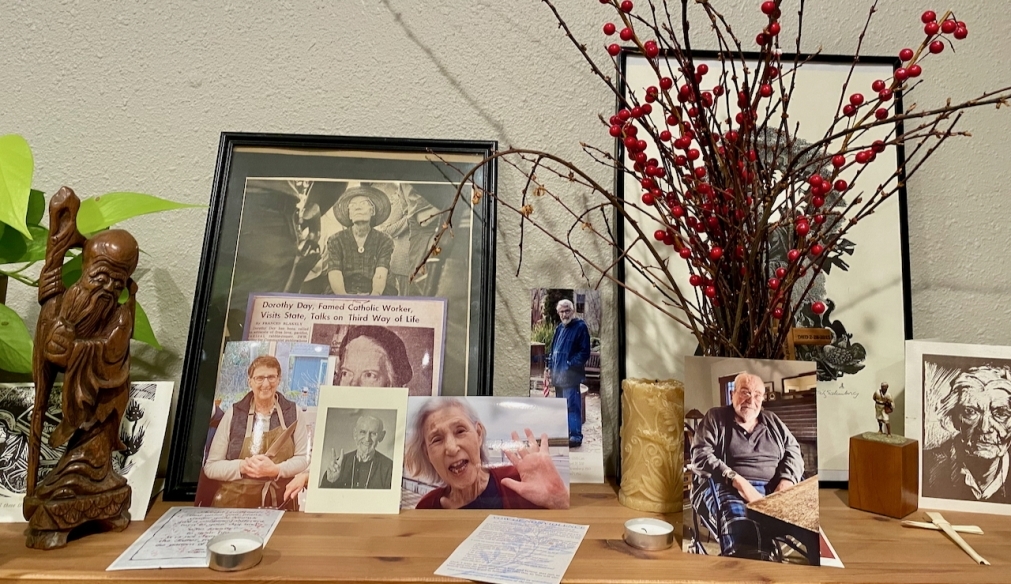
Ancestor Altar at Dandelion House
This past July my grandmother herself died at the full age of 100. That house in Busshozan has long ago been sold, and the altar is gone. Her only child (my mother) and three grandchildren are scattered across the globe, and I wonder how we will keep alive our connection to her, and all of our ancestors who came before her.
My grandmother, or Chama, as we called her, was the storyteller of the family. She entertained us with stories of her childhood in Ayabe, where she played with the daughter of the high priestess, or of her teenage years in Manchuria, then under Japanese colonial rule. In each story I can still hear her adventurous spirit and the quiet pleasure she took in breaking the rules.
“The deep wisdom of the dual feasts of All Saints and All Souls is the recognition that we are all beings-in-progress, and yet, we somehow all belong.”
In Christianity, November is traditionally the month to remember the dead, and I’ve been reflecting on Chama and her impact on my life. I’ve inherited much from her: the shape of her face, her love of storytelling, and perhaps most importantly, her spirit of hospitality. After Japan lost the Second World War, she and my grandfather eventually settled into that home they built in Busshozan, back on the Japanese mainland. They were among the lucky ones, for although they lost everything in the war, my grandfather still had his education as a medical doctor, and by practicing his profession he was able to make a living to support his family.
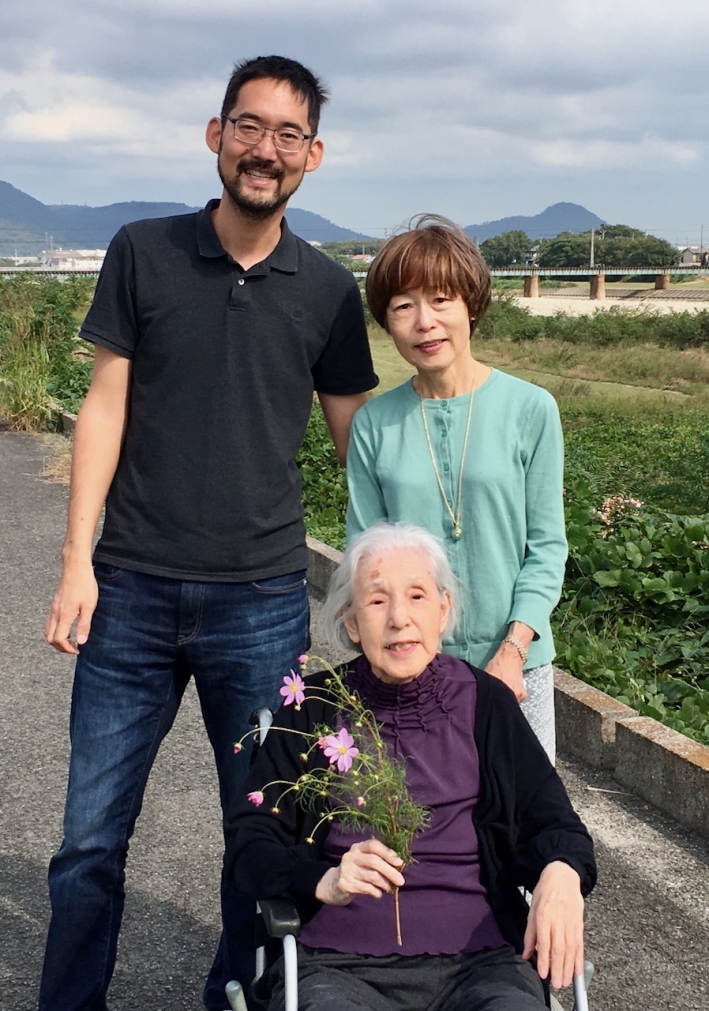
Fumi, Fumi’s mom, and Chama in 2018
Over the years, their home in Busshozan became a hub for a steady flow of relatives, friends, and strangers with nowhere else to go. I imagine Chama, the matron of the family, overseeing a chaotic household, making sure the children were fed, the nurses paid, insurance billed, the cooks and housekeepers kept busy. I remember the story of one young man who had, as my grandparents put it, “lost his way.” They built a cottage for him in the backyard, where he lived for several years until he found his way again, eventually opening up a successful sporting goods store.
I like to think I inherited some of Chama’s gifts of hospitality. Visit Dandelion House on any Thursday afternoon, and there is a bit of that same organized chaos as Lisa returns from a trip to the Chef’s Store, Julian directs half a dozen volunteers in preparing our street meal for 150, volunteers and neighbors stop by with donated garden produce and baked goods, and I attempt to prepare our community dinner for the evening while not getting in the way. Underneath the chaos, I hope, is some of that same sense of home and belonging I felt as a child visiting the house in Busshozan.
Inheritance is complicated, however, and in honoring Chama I know I need to remember her shadow side also. Chama was racist. In telling stories of growing up in Manchuria, she would warn me that “you can’t trust Chinese people – look the other way, and they will steal from you.” The comment, I’m sure, comes from her own experience as a teenager of having precious belongings disappear from her home; yet, she never developed the critical analysis to recognize that the petty theft of her Chinese servants were but desperate responses to the large scale theft of land, wealth, and people by the Japanese Empire. And though she ran an efficient household, even as a child I noticed the slight condescension with which she addressed the housekeeper, the nurses, and the shopkeepers who came to offer their wares.
And so, I ask myself, what of Chama’s shadows have I also inherited? Do I subtly look down on the poor and uneducated, even as I seek to serve? What racist notions are still lodged deep in my psyche?
The deep wisdom of the dual feasts of All Saints and All Souls is the recognition that we are all beings-in-progress, and yet, we somehow all belong. Recognizing the shadows our ancestors carry does not have to take away from honoring them and their spirits. And so, at Dandelion House we have our own Ancestor Altar, honoring our personal ancestors as well as our forbearers in the movement for social justice, each of them flawed, each of them holy. On our altar are famous saints like Francis of Assisi and Catholic Worker co-founder Dorothy Day. They share space with less famous but no less holy friends like Father Louie Vitale, the Franciscan priest and activist, Father Robert Hale, a Camoldalese monk who introduced first Julian and Lisa to each other, then me to Julian (and through Julian, Lisa), Barbara Limandri, a meal prep volunteer and our “Chopper-in-Chief,” and, the latest member of our Cloud of Witnesses, Terry Voss, dear friend and mystic.
If you’d like to add to our altar, please mail, email, or bring by a photo, prayer request, or memento of a loved one or ancestor in the movement. We will collect
them and honor them on our altar for the month of November. We won’t be able to
return your items, so please only send copies. May all of our ancestors give us
strength for the work ahead.