
Wisdom from the Margins
Ash Wednesday 2026
by Fumi

There is a famous story about Jesus that is always read on the First Sunday of Lent, sometimes called “The Temptation in the Desert.” In it, Jesus is offered three opportunities by the devil: to rule over all the empires of the world, to turn stones into bread, and to impress the people by jumping off the Temple parapet (Matthew 4:1-11; Luke 4:1-13). Placed right at the beginning of Jesus’ public life, the story speaks of Jesus’ struggles to discern what his life will be about and the strategies he will use to accomplish his goals. Perhaps every leader faces such a moment, when they must choose for themselves their unique path in life.
How often I’ve wished that Jesus might have said “yes” to all three of these temptations! Whenever I feel powerless to affect change amidst injustice, I imagine how different our world would be if it were ruled over by someone with the heart and compassion of Jesus. As I witness suffering, hunger, and the houseless multitudes on the streets of Portland, I think how much more abundant the world would be if we could just turn this stone into bread, that boulder into an apartment. And, what, exactly, would have been so wrong for a religious leader with Jesus’ vision to also have the charisma to awe and dazzle the crowds? Instead, he said, “no,” and as a result he was executed by empire, the poor remained poor, and even his small band of followers (save a few courageous women) abandoned him.
And yet, in a time when white Christian nationalists project an image of a domineering Jesus, perhaps it is more important than ever to reclaim the Jesus of the Gospels who is, as the President might say, “a loser.” From his birth to refugee parents to his death on a cross, Jesus consistently lead with vulnerability rather than domination, compassion rather than vengeance.
Our country is at a crossroads. Federal agents terrorize communities with impunity. Yesterday, Chicago, today, Minneapolis, tomorrow, perhaps, Portland. As people of conscience, we, too, must discern our path. How do we build a movement strong enough to counter a police state?
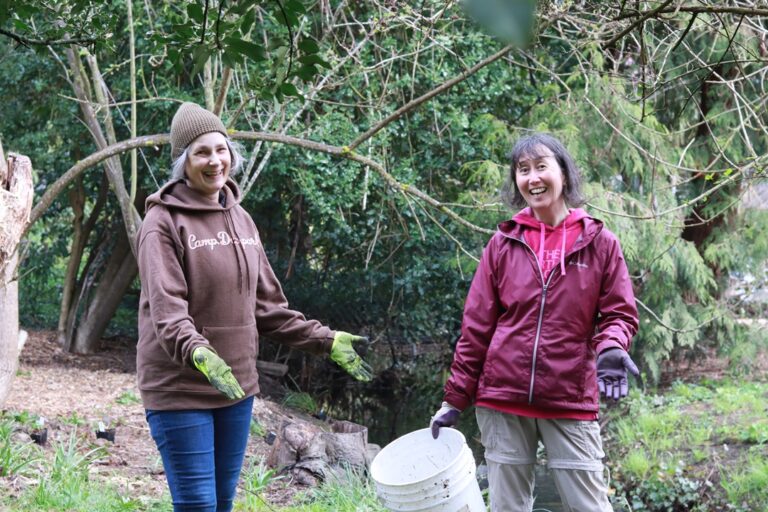
Working in the garden.
Our country is at a crossroads. As people of conscience, we, too, must discern our path. How do we build a movement strong enough to counter a police state?
Perhaps this is a good moment to confess that I feel as overwhelmed and lost as you do. I wish I could point to all that we are doing at Dandelion House to rise to this moment, and rally you to join. In fact, we don’t have the answers. We know that what we currently do – offering housing, food, and love to
those perennially excluded by society – is important but hardly enough. We are grasping for a way forward. And, as Catholic Workers, we look to Jesus when we are most lost.
The story offers some pointers. As the narrative progresses, Jesus clearly rejects, in turn, conventional political, economic, and religious power. With each “no,” he moves further and further into the margins. This is a story, then, about the rejection of the imperial status quo and its methods for maintaining power. The means of empire cannot be the means of our liberation.
So we ask ourselves at Dandelion House: how are we still beholden to the ways of empire that Jesus rejected, and what would it mean to push ourselves further away from systems of domination? What would it look like to seek salvation not in conventional politics, wealth, or influence, but in the wisdom of marginalized communities? Can we let our imaginations and actions be shaped by the experiences of women, as well as queer, trans, neurodivergent, immigrant, BIPOC and poor people? Can we follow their lead?