
Seeds of Compassion
July 2026
by Julian
Recently, during one of our street meals under the Morrison Bridge, my heart was pierced while serving a young man a heaping plate of food. “Do you want more?” I asked after the first spoonful. “Yes, please, as much as you can spare.” “No problem, we’ve got plenty,” I said, as I dipped back into the pot. “Thank you so much, I haven’t eaten in two days. I’m so grateful you’re out here.”
Our interactions under the bridge run the gamut. Yes, we occasionally face difficult situations. We are working with people who carry enormous burdens of stress and suffering, after all. What consistently surprises me, though, is how often those we serve, who have every reason to be enraged with the world, are simply, sincerely grateful. Even so, my conversation with this particular young man struck differently somehow. “I’m glad we get to be out here, but I wish we didn’t have to,” I told him. But my reply did not reflect how deeply moved I was by his words.
Here in the United States, as I write, we are approaching Independence Day, the 250th anniversary of our nation’s independence from British colonial rule. Yet, for all the fanfare and celebration, we appear to be in a collective freefall into ever-deepening oligarchy and authoritarianism—rule by a wealthy elite abetted by the rapid dismantling of democratic norms. And while this trajectory contradicts the stated ideals of the Declaration of Independence, the seeds of our current unravelling were present from the beginning. Perhaps none saw this more clearly than the earliest victims of European settler violence.
People who identify with one another, who empathize with one another’s needs and suffering, do not seek their own security and happiness at others’ expense.
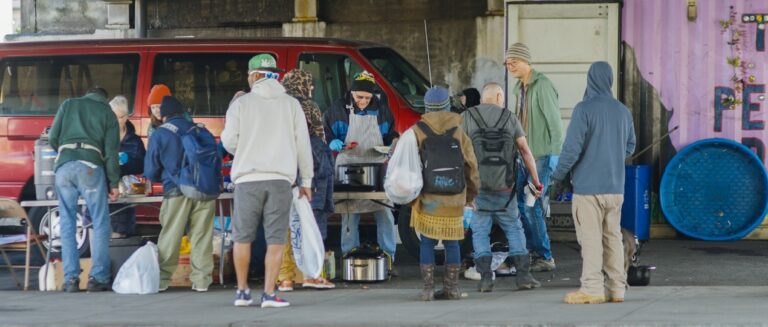
Friday meal service. Photo by Autie Carlisle
As the Oglala Sioux Medicine Man Black Elk observed, reflecting on his first trip to New York City:
I could see that the Wasichus [white men] did not care for each other the way our people did before the nation’s hoop was broken. They would take everything from each other if they could, and so there were some who had more of everything than they could use, while crowds of people had nothing at all and maybe were starving. This could not be better than the old ways of my people.
This destructive shadow-side of our spirit of independence has now pushed us to a critical juncture. The very life systems of our planet cannot continue to sustain our mad rush to acquire and control. We are engulfed by a polycrisis of our own making. And our political and economic systems, our social cohesion and cultural resilience, are all buckling under the pressure.
And yet, if Black Elk’s words diagnose the malady, they also point toward the remedy. People who identify with one another, who empathize with one another’s needs and suffering, do not seek their own security and happiness at others’ expense. Contrary to the logic of American rugged individualism, we only truly flourish to the extent that all of us can flourish. A new spirit of interdependence, rather than a malignant independence that consumes without conscience or
concern for the wellbeing of others, must become the declaration upon which we transform our lives, our nation, and our world.
While this transformation may seem like an impossible undertaking, its seeds lie in simple contact with other people’s suffering. It is nurtured by serving a hungry young man a plate of food and, in a moment of tender recognition, knowing myself to be inseparable from his need. It is fostered by our dreaming and creating new ways of sharing our resources, talents, and energies that invite others into our circle of care and community.
We are currently immersed in all of the excitement, hard work, and busyness of expanding to a second house. We are growing as a community and in our capacity to offer hospitality to those in need. And still we remember to allow our hearts to be broken open by the suffering of our neighbors, human and more than human—to remain grounded in personal relationships. This is how we tend the seeds of a new world, even as we resist the forces that destroy life and seek to diminish our empathy and compassion.